Comparison in Single Mode Beam

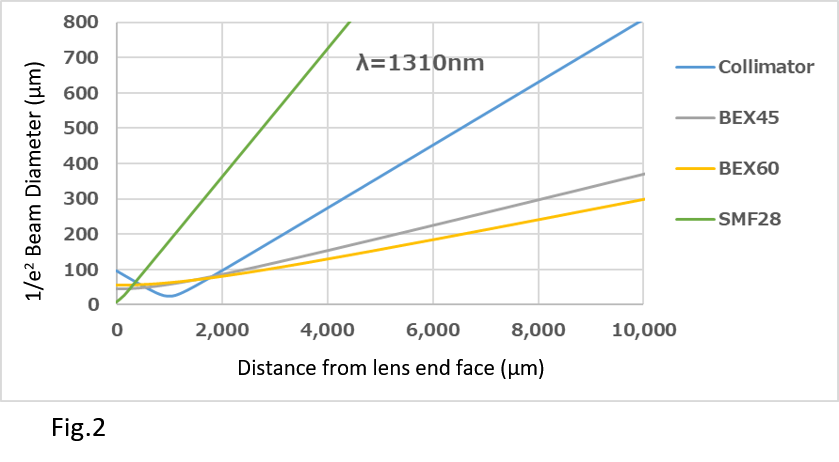
The diagram above illustrates the spread of the beam diameter of single-mode light emitted from the tip of an optical fiber and an optical fiber lens (wavelength = 1310 nm).
The yellow-green light is the light emitted from a standard single-mode optical fiber (SMF28), and although it is thin at the output, it spreads considerably about 2.0 mm away and continues to spread at the same angle after this.
In contrast, the gray and orange beam with a SILICAGRIN BEX (Beam Expander) attached to the output point continues to extend at a thin diameter, and the blue SILICAGRIN Collimator further thins at around 1.0 mm. This is the effect of SILICAGRIN fiber lens (GRIN lens).
The graph on the right shows each of these data (theoretical values).
Effect of ultra-fine single mode beam
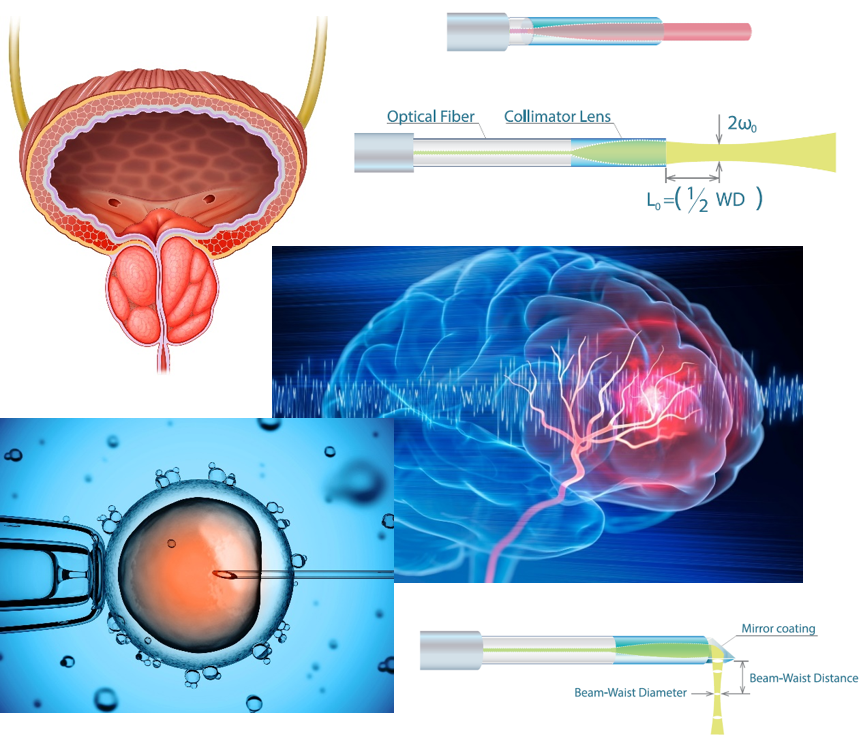
What are the advantages of the ultra-thin single-mode beam of the SILICAGRIN BEX, which can achieve an extremely thin diameter of less than 0.5 mm even at a distance of a few millimeters to 1 cm, and the SILICAGRIN Collimator, which has a diameter of only 20 to 30 µm (0.02 to 0.03 mm) at around 1 mm, for laser medical devices?
For example, in resection devices, it may become a “scalpel with a blade thickness of less than 0.1 mm.” New devices that simultaneously achieve minimal bleeding and hemostasis by laser are conceivable.
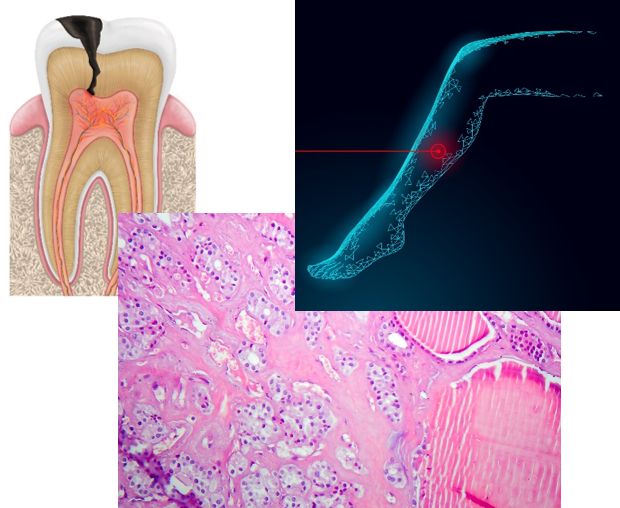
In addition, cauterization, vaporization, PDD/PDT, and even the most advanced i-PDT, may enable ultra-fine selective treatment by treating only minute affected areas with straight or side-emitting collimated beams.
Furthermore, it may be used for delicate manipulation of cells and fertilized eggs.
Comparison with multimode beam
SILICAGRIN is also effective for multimode beams (GI/SI) that are often used in laser medicine.
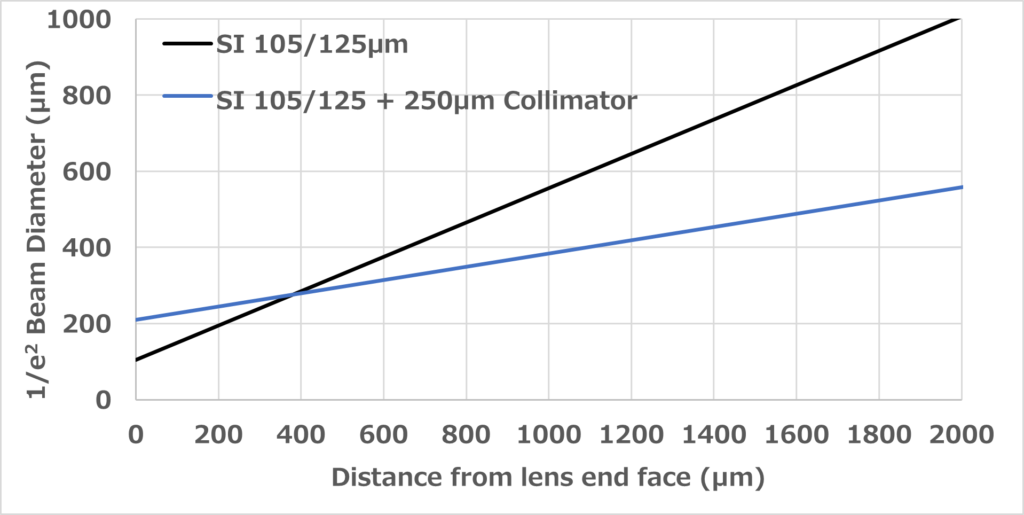
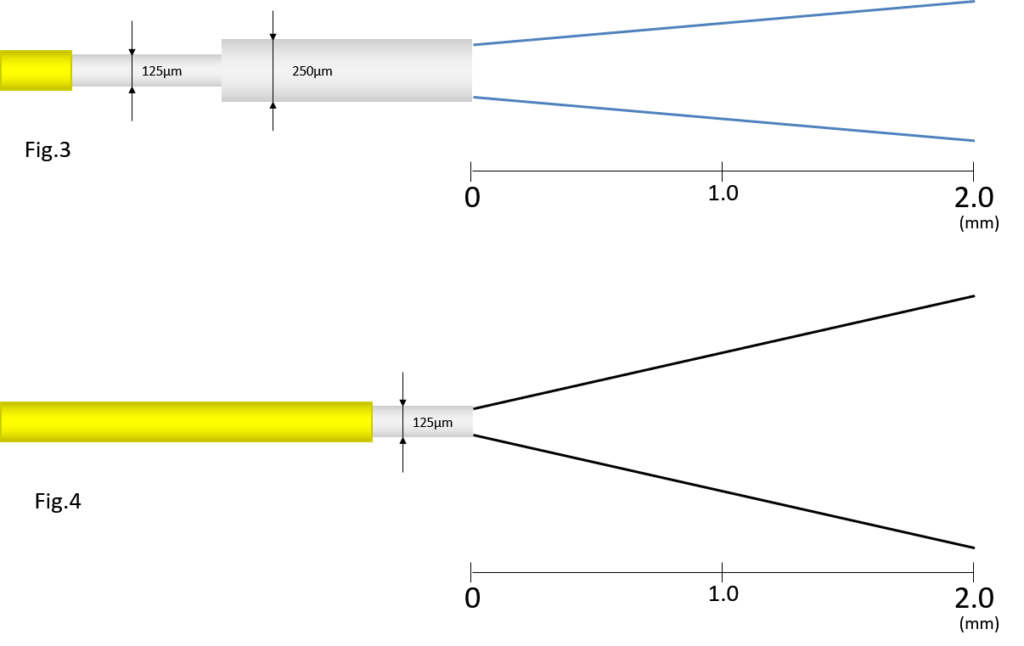
Figure 3 shows the spread of a multimode beam when a 250µm SILICAGRIN Collimator is attached to the tip of an SI (Step Index) fiber (NA=0.22) with a core diameter of 105µm and a cladding diameter of 125µm. Even at a distance of 2.0mm, the spread of light is suppressed to a diameter of about 0.5mm.
In contrast, when an SI fiber with the same core diameter of 105µm and cladding diameter of 125µm in Figure 4 is cut and emitted without a lens, it spreads to a diameter of more than 1mm at the same distance of 2.0mm.
If the diameter is 1/2, the irradiation area becomes 1/4, allowing for precise irradiation with highly concentrated laser power. This can also be represented graphically as shown below (theoretical values).
The effects of multimode can be controlled
What are the benefits of a “controlled multimode beam” for laser medical devices?
As mentioned before, the multimode beam from the SILICAGRIN Collimator, which has a diameter of 1/2 and an irradiation area of 1/4, allows for precise laser irradiation with high energy concentration. When high-power irradiation of the affected area is required for vaporization or ablation, selective and safe treatment may be possible by reducing the output from the laser light source and concentrating the light energy only on the affected area.
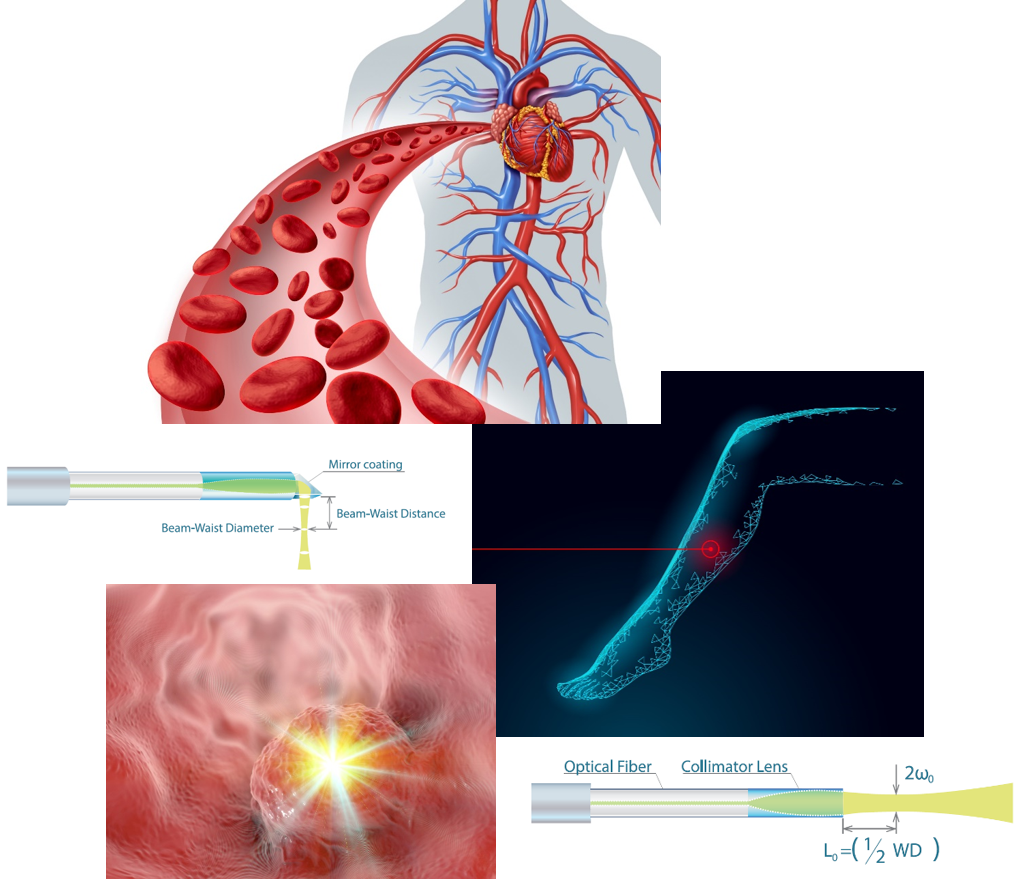
Furthermore, by taking advantage of the lens characteristics of the SILICAGRIN Collimator, which gradually expands to a maximum of nearly 250 µm within the fiber lens, various beam controls can be considered according to the application, such as diffusion by side processing and circular beam emission by tip conical processing.
A special beam shape is also available – SILICAGRIN Condenser
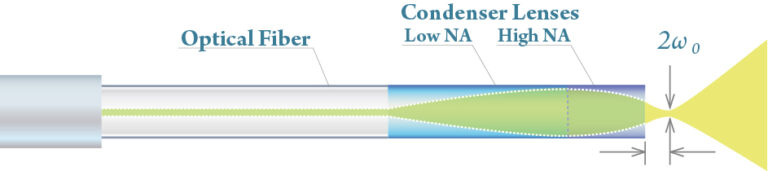
Unlike the SILICAGRIN BEX, which maintains a constant thin beam over long distances, and the SILICAGRIN Collimator, which focuses at a desired distance, the SILICAGRIN Condenser, which has two types of lenses fused in series, has a special beam shape as shown in the figure above.
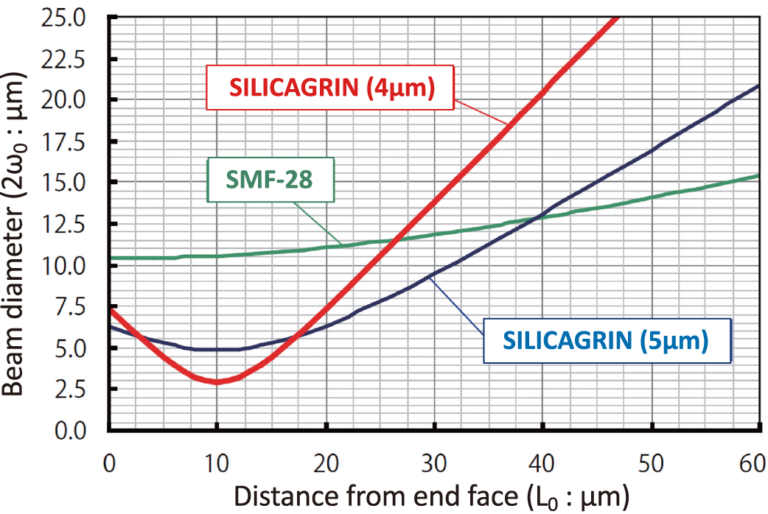
It has two features. 1) A beam thinner than the core of a typical single-mode fiber (SMF28) can be obtained in space (minimum diameter 4µm), and 2) it diffuses rapidly at a steeper angle than a single-mode fiber.
The thin beam in 1 realizes high-energy density laser light, and 2 suggests the possibility of wide-area irradiation and as a fiber-type ultra-thin focusing lens.
The SILICAGRIN Condenser, with a diameter of only 125µm, can be used not only for ablation but also for irradiation/focusing probes and in vivo internal microscopy, making it possible to “insert a relay lens into the body.”